
All MCP Servers Complete list of MCP server implementations, sorted by stars
The Legion Database MCP Server facilitates seamless database interactions by integrating the Legion Query Runner with the Model Context Protocol (MCP). It supports various databases, exposes database operations as MCP resources, tools, and prompts, and offers flexible deployment options. This server is ideal for AI applications requiring context-aware database access and query execution.

The SearXNG MCP Server allows AI assistants to conduct web searches through SearXNG, a privacy-focused metasearch engine. It supports zero-configuration setup by automatically selecting a random public instance from SearX.space, while also offering private instance support with basic authentication. The server provides customizable search parameters, privacy-focused results, and markdown-formatted outputs, making it ideal for integration with AI tools like Claude and Smolagents.

The Plex MCP Server provides a standardized JSON-based interface for automating and integrating Plex Media Server with AI systems and other tools. It supports multiple transport methods, including stdio and Server-Sent Events (SSE), and offers a rich set of commands for managing libraries, media, playlists, collections, users, and more. This server is designed to facilitate seamless interaction between Plex and automation platforms or custom scripts.

This project implements a Model Context Protocol (MCP) server that bridges natural language interactions with Azure DevOps REST API. It allows AI assistants to manage work items, pipelines, pull requests, and more. Built with the MCP Python SDK and Azure DevOps Python API, it simplifies DevOps tasks through conversational AI.
The MCP Tree-sitter Server is designed to enable Claude, an AI assistant, to intelligently access and analyze codebases with appropriate context management. It supports multiple programming languages, including Python, JavaScript, TypeScript, Go, Rust, and more, using tree-sitter for AST-based understanding. Features include flexible code exploration, context management, symbol extraction, dependency analysis, and caching for optimized performance.

The OpenDigger MCP Server is designed to facilitate interaction between Large Language Models (LLMs) and OpenDigger data. By integrating with MCP tools, this server allows users to retrieve and analyze online data from OpenDigger, providing valuable insights. It serves as a bridge for LLMs to access structured data efficiently.


MCPWizard is a command-line interface (CLI) tool designed to simplify the creation, management, and deployment of Model Context Protocol (MCP) servers. It supports project initialization, tool management, server building, and deployment, along with generating Claude Desktop configuration files. The tool currently supports TypeScript and Python templates, with plans to expand features like MCP resources, prompts, and transport support.
The AniList MCP Server is a Model Context Protocol (MCP) implementation designed to interact with the AniList API. It enables LLM clients to search for anime, manga, characters, and staff, as well as access user profiles, lists, and advanced filtering options. The server supports authenticated operations like favoriting media and updating user lists, making it a powerful tool for integrating AniList data into AI workflows.

This MCP server is designed to enhance academic workflows by integrating with Canvas and Gradescope platforms. It offers features such as fetching assignment deadlines, calendar integration, and file management. The server can be easily set up using a helper script or manually configured, and it supports tools for downloading course materials and managing deadlines.

This repository provides a set of Model Context Protocol (MCP) server implementations designed to enable Large Language Models (LLMs) to interact with DevOps systems. These servers offer a standardized way to automate and control infrastructure, deployment pipelines, monitoring, and other DevOps operations. Each implementation includes comprehensive tools that map to the respective DevOps platform's API, allowing LLMs to perform complex operations through simple function calls.

Axiom is an AI agent specialized in modern AI frameworks, libraries, and tools. It helps users create AI agents, RAG systems, chatbots, and full-stack development projects through natural language instructions. Built with LangGraph, MCP Docs, Chainlit, and Gemini models, it offers an interactive chat interface, access to multiple documentation sources, and customizable model settings. It also supports Docker for containerized deployment.
The MCP Kubernetes Server enables seamless management of Kubernetes clusters using the Model Context Protocol (MCP). It provides a natural language interface for performing common Kubernetes operations, such as creating deployments, scaling resources, and updating configurations. This server integrates with Large Language Models (LLMs) to simplify Kubernetes management, reduce command complexity, and ensure type-safe interactions.
The Adfin MCP Server facilitates seamless integration between Claude Desktop and Adfin APIs, allowing users to perform financial operations such as credit control checks, invoice creation, and bulk invoice uploads. It leverages Python and the uv package manager to ensure smooth operation and automatic updates of Adfin API tools within the Claude interface.
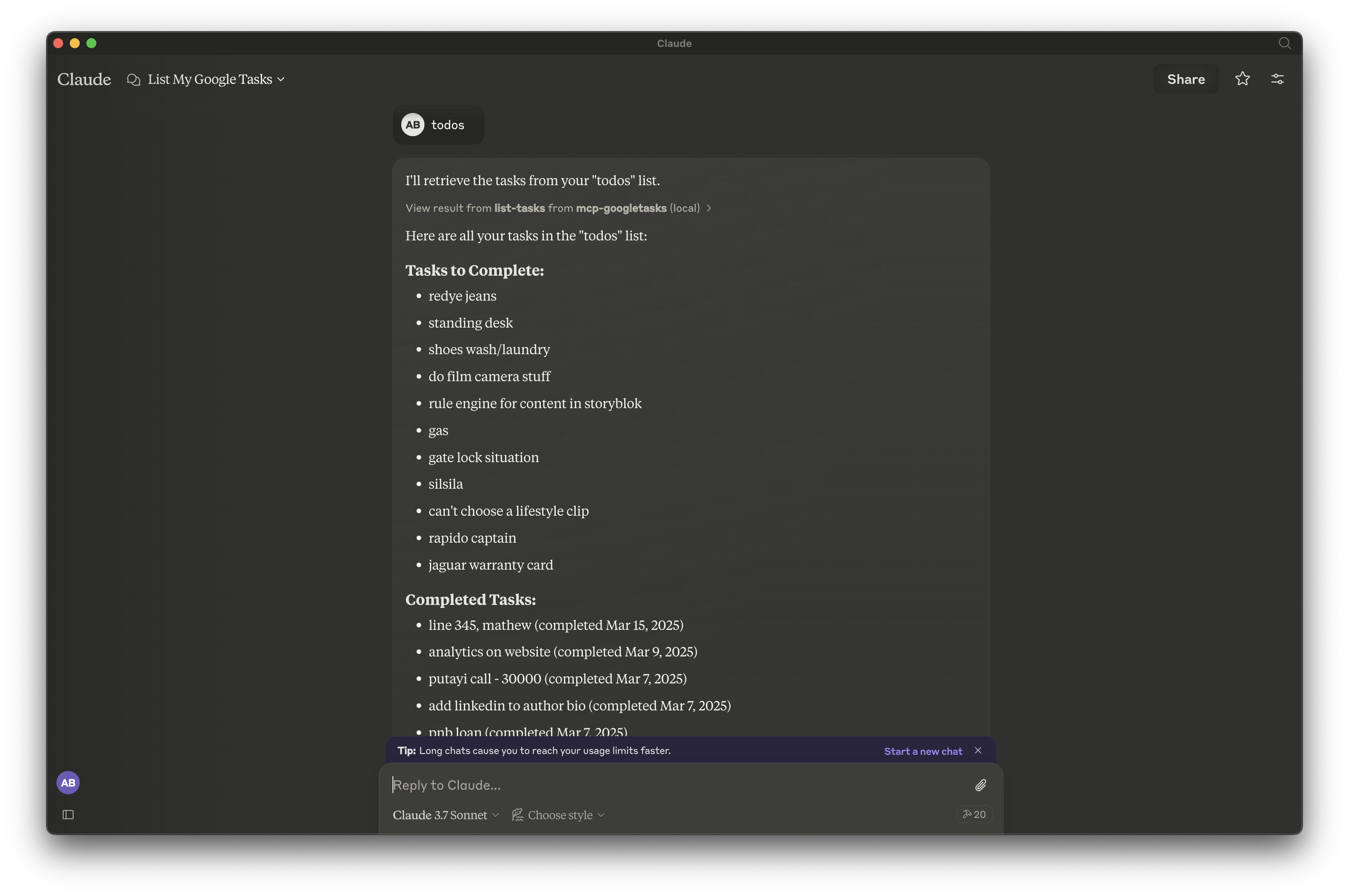
This Model Context Protocol (MCP) server acts as a bridge between Claude and Google Tasks, enabling users to manage their task lists and tasks seamlessly through Claude. It supports various operations such as listing, creating, updating, and deleting tasks and task lists. The server requires a Google Cloud Project with the Tasks API enabled and is built using Node.js. It is designed to be used with Claude for Desktop, providing a convenient way to handle Google Tasks via Claude's interface.
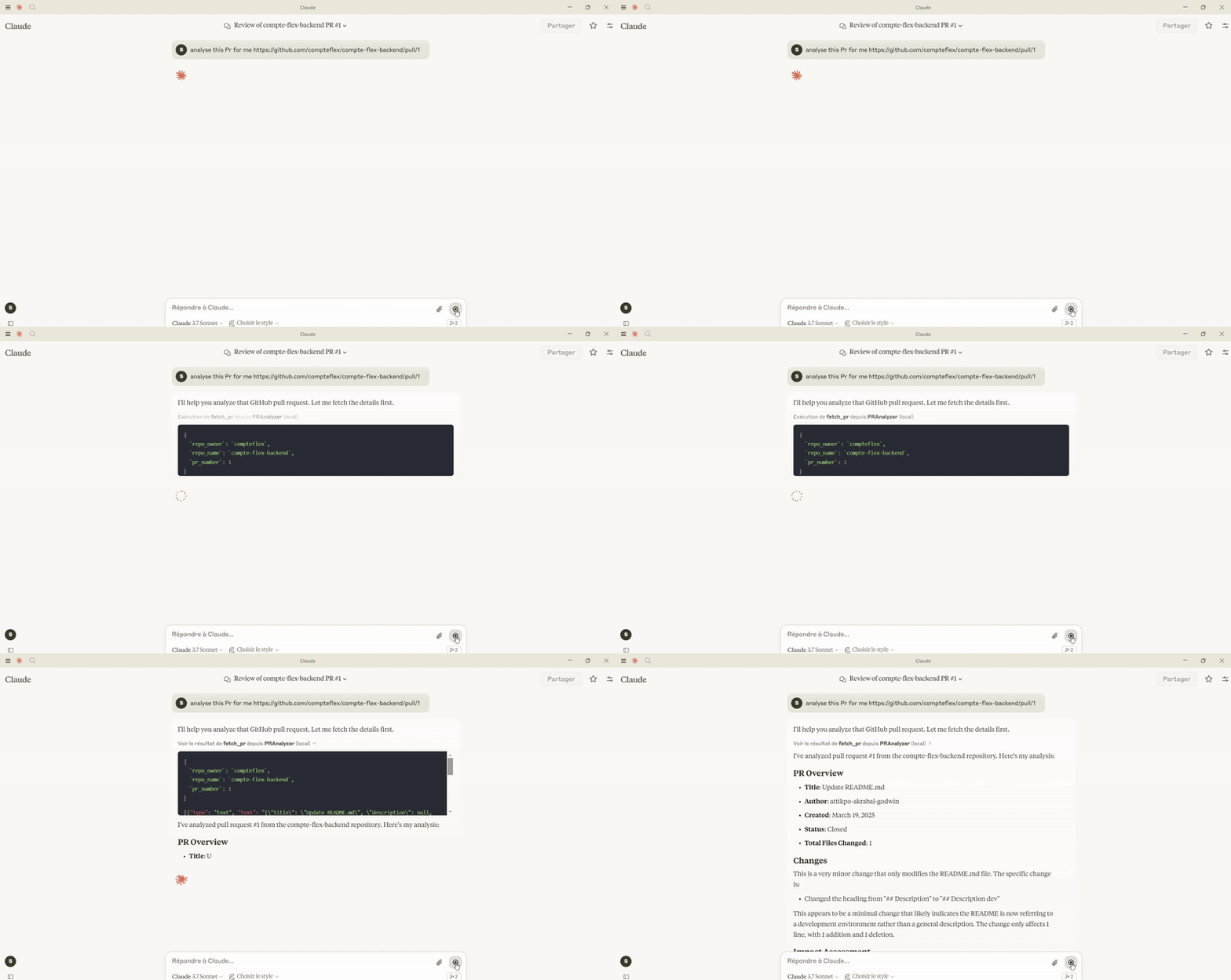
PR Reviewer is a tool that fetches changes from GitHub pull requests and creates detailed reports in Notion. It leverages the MCP (Model Context Protocol) to facilitate communication and integration between different services. The tool includes features like fetching PR changes, generating reports, and using an MCP server for handling analysis requests.
 Invite Gmail Contacts


